Sustainability & Environmental Impact
IBC recycling is not just what we do — it is why we exist. Every container we recondition or recycle represents a tangible reduction in plastic waste, carbon emissions, and landfill burden.
Get a Free Quote
Tell us what you need — we respond within 24 hours.
The Hidden Environmental Cost of Industrial Containers
An estimated 1.5 million intermediate bulk containers are discarded in the United States every year. Each 275-gallon IBC tote contains approximately 130 pounds of high-density polyethylene (HDPE), 75 pounds of galvanized steel, and a wooden or composite pallet. When these containers are landfilled instead of recycled, the environmental cost is staggering.
Manufacturing a single new IBC tote generates roughly 150 kg of CO2 equivalent emissions. The virgin HDPE requires petroleum extraction and processing. The steel cage demands ore mining and smelting. By extending the useful life of existing containers through reconditioning, we avoid this entire upstream environmental burden.
At Baltimore IBC Recycling, we see every used tote as an opportunity — an opportunity to prevent waste, reduce carbon emissions, conserve raw materials, and provide affordable containers to businesses that need them.
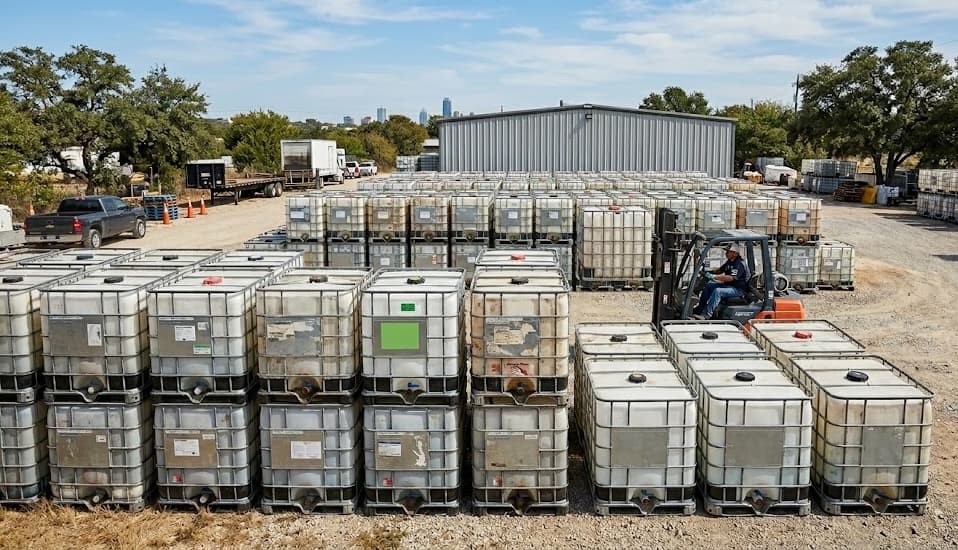
From Linear Waste to Circular Value
The traditional “take-make-dispose” model treats IBC containers as single-use items. Our circular approach keeps materials in productive use for as long as possible, extracting maximum value at every stage.
Reuse
The most environmentally beneficial option. When an IBC tote passes our inspection — structurally sound cage, intact inner bottle, functional valve — we clean and recondition it for direct resale. This avoids 100% of the manufacturing emissions associated with producing a new container.
A properly maintained IBC can go through 5 to 7 reuse cycles before the inner bottle degrades beyond repair. Our reconditioning process includes triple-rinse cleaning, pressure testing to 15 PSI, valve inspection or replacement, and cage straightening as needed.
Rebottle
When the inner HDPE bottle has degraded but the steel cage and pallet remain serviceable, we install a brand-new inner bottle. This process — known as rebottling — extends the cage's useful life by another 5-7 cycles while using only a fraction of the materials required for an entirely new IBC.
Rebottled IBCs offer near-new performance at a significantly lower cost and environmental footprint. They are suitable for food-grade, pharmaceutical, and chemical applications depending on the bottle specification used.
Recycle
When an IBC reaches the end of its reusable life, we disassemble it into component streams for material recycling. The HDPE bottle is shredded and sent to pelletizing facilities for use in new plastic products. The steel cage goes to metal recyclers. Wooden pallets are repaired, chipped for biomass fuel, or composted.
Our 100% material recovery rate means that no part of any IBC container we process ever reaches a landfill. Even valve components and gaskets are sorted and recycled through specialized streams.
Our Environmental Numbers
We do not just talk about sustainability — we measure it. Here is the cumulative impact of our operations since 2018.
Plastic Diverted from Landfills
HDPE bottles reconditioned or recycled into pellets
Steel Recovered & Recycled
Galvanized steel cages returned to the metal supply chain
CO2 Emissions Avoided
By reconditioning instead of manufacturing new IBCs
IBC Containers Processed
Each one inspected, tracked, and responsibly managed
How IBC Recycling Reduces Plastic Waste
Avoiding Virgin Plastic Production
Each IBC inner bottle contains about 130 pounds of HDPE. Manufacturing this plastic from virgin petroleum requires extracting crude oil, refining it into ethylene, polymerizing it into HDPE resin, and then blow-molding the bottle. By reusing existing bottles, we eliminate this entire energy-intensive chain. When the bottle must be replaced, the old one is shredded and recycled into post-consumer HDPE products rather than being landfilled.
Preventing Microplastic Contamination
When HDPE containers degrade in landfills, they break down into microplastics over decades. These particles enter soil, groundwater, and eventually waterways. By intercepting IBC totes before they reach landfills and either reusing or properly recycling them, we prevent the creation of microplastic pollution at its source.
Reducing Industrial Water Usage
Manufacturing a new IBC tote from scratch uses significantly more water than our reconditioning process. Our closed-loop wash system recycles approximately 80% of the water used in cleaning, and the remaining wastewater is treated before discharge. Compared to new production, reconditioning uses an estimated 90% less water per container.
Steel Recovery and Reuse
The galvanized steel cage surrounding each IBC bottle weighs roughly 75 pounds and is highly durable. In most cases, cage life far exceeds inner bottle life. We repair and reuse cages through multiple bottle replacements, and when a cage finally reaches end-of-life, steel is one of the most recyclable materials on earth — it can be melted and reformed indefinitely without quality degradation.
Pallet Lifecycle Extension
The wooden or composite pallet at the base of each IBC is often overlooked in recycling discussions, but it represents significant embodied energy. We repair damaged pallets whenever possible. Those beyond repair are chipped and used as biomass fuel or landscape mulch, ensuring even this component avoids landfill disposal.
Carbon Footprint Reduction
Our lifecycle analysis shows that reconditioning a used IBC tote produces approximately 85% fewer carbon emissions than manufacturing a new one. This includes collection transport emissions, cleaning energy, and any replacement parts. For every 1,000 totes we recondition instead of replacing with new ones, we prevent roughly 150 metric tons of CO2 equivalent from entering the atmosphere.
Carbon Footprint Reduction
Our lifecycle analysis quantifies the carbon savings from reconditioning and recycling IBC totes versus manufacturing new ones. The numbers tell a compelling story.
How We Calculate Our Carbon Savings
Manufacturing a single new 275-gallon IBC tote from virgin materials generates approximately 150 kg (330 lbs) of CO2 equivalent emissions. This includes petroleum extraction and refining for the HDPE bottle, iron ore mining and steel smelting for the cage, lumber harvesting and processing for the pallet, and all associated transportation.
By contrast, our reconditioning process — collection, cleaning, inspection, minor repairs, and redistribution — generates approximately 22 kg (48 lbs) of CO2 equivalent per container. That is an 85% reduction in carbon emissions per unit.
Even when a container cannot be reconditioned and must be recycled for materials, the carbon savings are significant. Recycling HDPE uses 88% less energy than producing virgin HDPE, and recycling steel uses 74% less energy than smelting from ore.
CO2 to Manufacture One New IBC
Full lifecycle emissions including raw material extraction, manufacturing, and transportation.
CO2 to Recondition One Used IBC
Including collection transport, cleaning energy, water treatment, and any replacement parts.
Carbon Reduction Per Reconditioned Unit
Each tote we recondition instead of replacing saves 128 kg of CO2 equivalent emissions.
Metric Tons of CO2 Avoided Since 2018
Equivalent to taking approximately 490 passenger cars off the road for one year.
Cars' Worth of Annual Emissions Prevented
Based on the EPA average of 4.6 metric tons of CO2 per passenger vehicle per year.
Reduction in Our Fleet Emissions Since 2024
Achieved through route optimization software and upgraded fuel-efficient vehicles.
Water Conservation Efforts
IBC reconditioning requires water for cleaning, but we have invested heavily in minimizing our water footprint through closed-loop systems and advanced treatment.
Closed-Loop Wash System
Our primary cleaning bays use a closed-loop water recycling system that captures, filters, and retreats wash water for reuse. This system currently recycles approximately 80% of all water used in our triple-rinse cleaning process, dramatically reducing our municipal water consumption.
Advanced Filtration Technology
Multi-stage filtration removes particulates, dissolved chemicals, and organic residues from our wash water before it is recycled. We use mechanical filtration, activated carbon treatment, and UV sterilization to ensure recycled water meets our cleaning standards.
Wastewater Treatment & Compliance
The 20% of water that cannot be recycled is treated on-site before discharge, meeting all Maryland Department of the Environment standards. We conduct monthly water quality testing and submit quarterly compliance reports to state regulators.
Comparison to New Manufacturing
Manufacturing a new IBC tote from virgin materials uses an estimated 450 gallons of water per unit when factoring in HDPE production, steel processing, and assembly. Our reconditioning process uses approximately 45 gallons per container — a 90% reduction in water consumption per unit.
Rainwater Harvesting
Our facility collects rainwater from our 60,000-square-foot roof for use in initial pre-rinse operations. This harvesting system supplements our municipal water supply and further reduces our freshwater consumption by approximately 15,000 gallons per year.
Goal: 95% Water Recycling by 2028
We are investing in next-generation filtration and treatment equipment that will increase our wash water recycling rate from 80% to 95%. This upgrade will reduce our net water consumption per container by an additional 75%, making our cleaning process among the most water-efficient in the industry.
Waste Diversion Metrics & Goals
Our commitment to zero-waste operations means tracking every material stream and ensuring nothing ends up in a landfill. Here is a detailed breakdown of our waste diversion performance.
Material Recovery Breakdown
Reconditioned for reuse or shredded and sent to pelletizing facilities for recycling into new plastic products
2,000,000+ lbs recovered
Repaired and reused across multiple bottle cycles, or sent to metal recyclers when no longer serviceable
1,100,000+ lbs recovered
Repaired for continued use, chipped for biomass fuel, or processed into landscape mulch
750,000+ lbs recovered
Functional valves are reused; worn components are sorted by material type and sent to specialty recyclers
45,000+ lbs recovered
Removed during cleaning and collected for proper disposal through licensed waste handlers
12,000+ lbs managed
Waste Diversion Goals
- ◆
Maintain 100% IBC Material Recovery
Continue ensuring that every component of every IBC container we process is either reused or recycled. Zero landfill tolerance for IBC materials.
- ◆
Achieve Facility-Wide Zero Waste by 2027
Extend our zero-waste commitment beyond IBC materials to include all operational waste: office supplies, PPE, cleaning agent containers, packaging materials, and food waste from our break room.
- ◆
Reduce Cleaning Agent Usage by 30%
By investing in more efficient wash systems and optimizing cleaning protocols, we aim to reduce our consumption of cleaning agents by 30% per container by 2028, without compromising cleaning quality.
- ◆
Divert 25,000 IBCs per Year by 2030
Scale our processing capacity to handle 25,000 containers annually, preventing approximately 3.25 million pounds of plastic and 1.8 million pounds of steel from reaching landfills each year.
How IBC Recycling Helps the Planet
To put the impact of IBC recycling into perspective, here are some real-world comparisons that show just how much difference each container makes.
Each Recycled IBC Saves 130 lbs of Plastic
That is equivalent to approximately 3,250 single-use plastic water bottles. When you recycle or recondition just one IBC tote, you are preventing the same amount of plastic waste as if you kept 3,250 bottles out of the trash.
One Reconditioned IBC Prevents 330 lbs of CO2
That is roughly equal to driving a car 370 miles. Every IBC we recondition instead of replacing with a new one saves as much carbon as a road trip from Baltimore to Boston.
Our Annual Operations Save Enough Plastic for 48 Million Water Bottles
Processing 15,000+ IBCs per year means we divert over 2 million pounds of HDPE plastic from landfills — enough to manufacture approximately 48 million standard water bottles.
Our Steel Recovery Could Build 55 Cars
The 1.1 million+ pounds of steel we have recovered from IBC cages is enough raw material to manufacture approximately 55 average passenger vehicles.
Water Savings Equal 250,000 Showers
By reconditioning IBCs instead of replacing them with new containers, we save an estimated 6 million gallons of water compared to new manufacturing processes — equivalent to about 250,000 average showers.
Energy Savings Could Power 200 Homes for a Year
The energy saved by reconditioning and recycling IBCs instead of manufacturing new ones totals approximately 2.4 million kWh since 2018 — enough to power roughly 200 average American homes for a full year.
Sustainability Goals 2025–2030
We set measurable targets and hold ourselves accountable. These are the goals guiding our operations through 2030.
25,000 Containers per Year by 2030
Scale our annual processing capacity from the current level to 25,000 IBC units, maximizing the number of containers we keep in productive circulation across the Mid-Atlantic region.
100% Renewable Energy Operations
Transition our facility operations to 100% renewable energy sources, including solar panels on our warehouse roof and renewable energy credits for grid electricity. Currently at 40% renewable.
Zero-Waste Certification
Achieve formal zero-waste certification by maintaining our 100% material recovery rate and implementing comprehensive waste tracking for all operational waste streams, not just IBC components.
Closed-Loop Water System
Achieve 95% water recycling rate in our wash operations through investment in advanced filtration and treatment systems. Currently recycling approximately 80% of wash water.
Regional Collection Network
Establish satellite collection points in five states (MD, VA, DE, PA, NJ) to reduce transport emissions and make it easier for businesses to participate in our buyback program.
1,000+ Business Partnerships
Build a network of over 1,000 businesses participating in our circular IBC ecosystem, including suppliers, buyers, and recycling partners. Currently serving 500+ customers.
Environmental Partnerships
We cannot build a circular economy alone. These are the organizations and programs we partner with to amplify our environmental impact across the region.
Maryland Department of the Environment
We work closely with MDE on regulatory compliance, wastewater discharge permitting, and best practices for used container processing. Our facility meets or exceeds all state environmental standards, and we participate in MDE's voluntary pollution prevention program.
Chesapeake Bay Foundation
As a supporter of the Chesapeake Bay Foundation, we contribute to watershed protection efforts and participate in their corporate sustainability program. Our water conservation practices directly benefit the Bay by reducing runoff and wastewater discharge into the Patapsco River watershed.
Baltimore Office of Sustainability
We collaborate with the city's Office of Sustainability on waste reduction initiatives and circular economy pilot programs. Our facility serves as a case study for Baltimore's 2030 Sustainability Plan, demonstrating how industrial recycling operations can create local jobs while reducing environmental impact.
Mid-Atlantic Plastics Recyclers Association
As active members of the regional plastics recycling association, we contribute to industry-wide standards for HDPE recycling, share best practices for container processing, and advocate for policies that support the circular economy for industrial packaging.
Local Material Recovery Facilities
We maintain partnerships with three regional MRFs that handle our end-of-life material streams. HDPE bottles go to a certified plastics pelletizer in Lancaster, PA. Steel cages are processed at a metal recycler in Dundalk, MD. This network ensures every component finds its highest-value second life.
Johns Hopkins Environmental Health & Engineering
We collaborate with Johns Hopkins researchers on lifecycle assessment studies for IBC reconditioning, providing operational data and facility access for their research into sustainable industrial packaging practices. These studies validate and refine our environmental impact calculations.
How Your Business Can Contribute
Sell Your Used IBC Totes
Instead of paying for disposal, sell your used IBC containers to us. You reduce your waste costs, earn revenue from containers you no longer need, and ensure they are properly reconditioned or recycled rather than landfilled.
Learn About Our Buyback Program→Buy Reconditioned
Choose reconditioned IBC totes over new ones. You get the same performance at a lower price, and you directly support the circular economy. Every reconditioned tote you purchase prevents a new one from being manufactured.
Browse Available Inventory→Schedule Regular Pickups
Set up a recurring collection schedule for your used containers. We provide flexible pickup services that integrate seamlessly with your operations, making sustainability effortless for your team.
Set Up a Pickup Schedule→Our Green Fleet
Every mile our trucks drive matters. We have invested in cleaner vehicles, smarter logistics, and innovative route planning to minimize the carbon footprint of our collection and delivery operations.
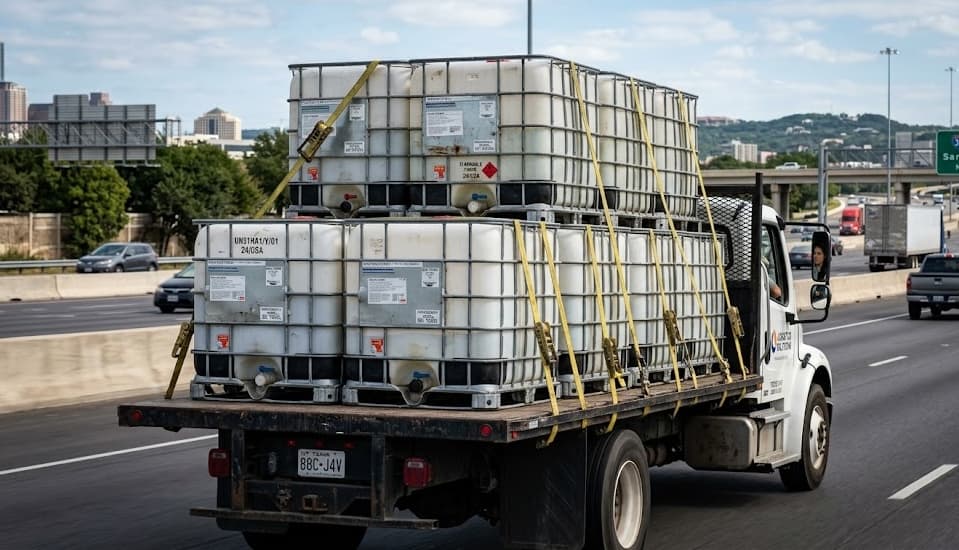
Delivering Sustainability on Every Route
Our fleet of fuel-efficient vehicles crisscrosses the Mid-Atlantic region daily, collecting used IBCs and delivering reconditioned containers. With AI-powered route optimization and eco-driver training, every mile is planned to minimize emissions and maximize efficiency.
Fuel-Efficient Fleet Vehicles
Our delivery and pickup fleet consists of modern diesel trucks that meet EPA Tier 4 Final emission standards, producing 90% less particulate matter and 80% less nitrogen oxide than older models. We have replaced all pre-2016 vehicles with fuel-efficient alternatives, reducing our fleet fuel consumption by 28% per mile since 2022. Each truck is maintained on a rigorous schedule to ensure peak fuel efficiency at all times.
Hybrid Vehicle Pilot Program
In 2025, we introduced two hybrid medium-duty trucks for local Baltimore-area routes where frequent stops and starts make hybrid technology most effective. These vehicles use regenerative braking to capture energy during deceleration, reducing fuel consumption by an additional 35% on urban routes. Based on the success of this pilot, we plan to expand to four hybrid trucks by mid-2027.
Electric Vehicle Roadmap
Our 2026-2030 plan includes a full transition to electric delivery vehicles for all routes under 100 miles. We have partnered with a commercial EV manufacturer to test two all-electric medium-duty trucks beginning in late 2026. Our facility is being equipped with Level 3 DC fast-charging stations to support an eventual all-electric fleet. By 2030, we aim for zero tailpipe emissions across all delivery operations.
AI-Powered Route Optimization
Our logistics team uses advanced route optimization software that analyzes traffic patterns, pickup and delivery locations, vehicle capacity, and time windows to create the most efficient routes possible. This system has reduced total fleet mileage by 22% since implementation in 2024, saving approximately 8,400 gallons of diesel fuel and 85 metric tons of CO2 per year. Routes are recalculated daily to account for new orders and cancellations.
Consolidated Load Planning
We combine pickup and delivery trips whenever possible, ensuring that trucks never run empty in either direction. Outbound deliveries of reconditioned IBCs are coordinated with inbound pickups of used containers along the same routes. This load consolidation strategy has increased our average truck utilization from 60% to 82%, meaning fewer total trips to serve the same number of customers.
Driver Eco-Training Program
Every driver in our fleet completes a quarterly eco-driving certification course covering fuel-efficient acceleration and braking techniques, optimal highway speeds, idle-reduction strategies, and tire pressure maintenance. Drivers who achieve the best fuel efficiency scores receive quarterly bonuses. Since implementing this program, we have seen a 12% improvement in average miles per gallon across the fleet.
Facility Energy Efficiency
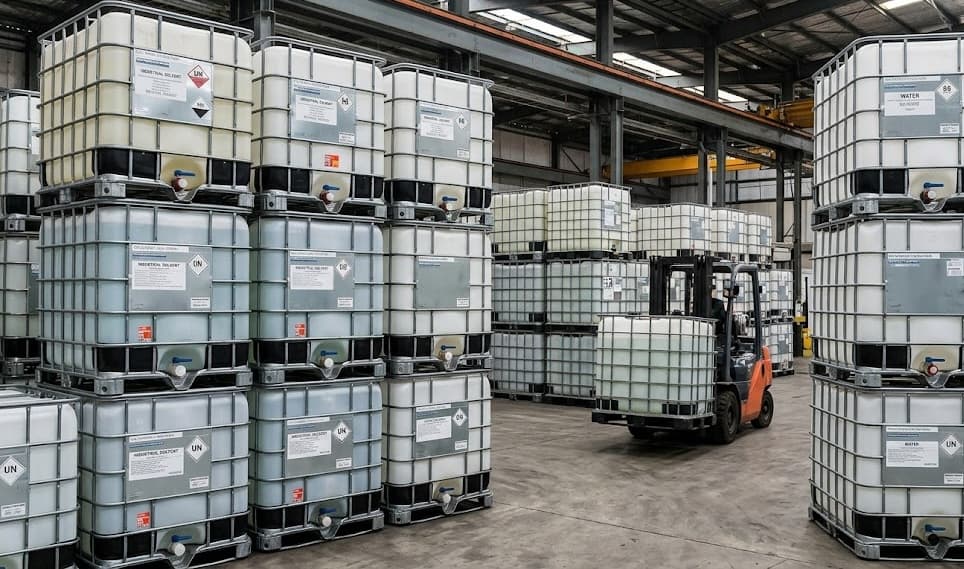
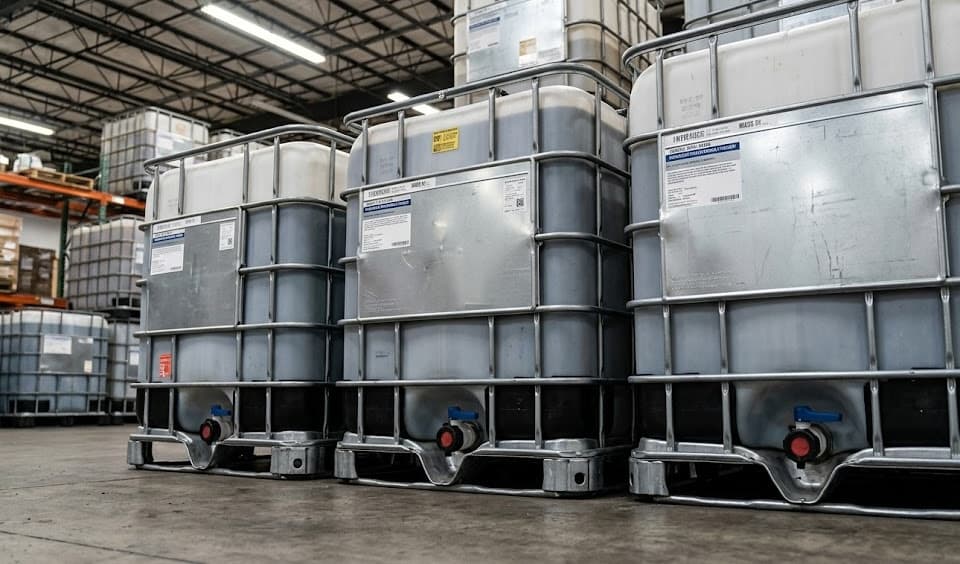
Our 60,000-square-foot processing facility in Baltimore is being transformed into a model of industrial energy efficiency. From solar panels to smart lighting, every upgrade reduces our environmental footprint and operating costs.
Solar Panel Installation
We are in the final planning stages of a 200 kW rooftop solar array that will cover approximately 15,000 square feet of our warehouse roof. Once operational in mid-2026, this system is projected to generate over 260,000 kWh of clean electricity per year — enough to offset approximately 50% of our total facility energy consumption.
The solar installation includes battery storage capacity of 100 kWh, allowing us to store excess daytime generation for use during evening shifts and cloudy periods. This reduces our reliance on grid power during peak demand hours when electricity generation is most carbon-intensive.
We estimate the solar system will prevent approximately 185 metric tons of CO2 emissions per year and pay for itself through energy savings within 7 years. Combined with our existing renewable energy credit purchases, we aim to reach 100% renewable electricity by 2029.
LED Lighting Retrofit
In 2024, we completed a full LED lighting retrofit of our entire facility, replacing 340 legacy fluorescent and metal halide fixtures with high-efficiency LED alternatives. The new lighting system produces the same brightness while consuming 65% less electricity. Motion sensors in low-traffic areas like storage rooms, offices, and restrooms automatically dim or shut off lights when no one is present.
The retrofit saves approximately 78,000 kWh of electricity annually — equivalent to the yearly consumption of 7 average American homes. Beyond energy savings, the LED fixtures provide better color rendering for our inspection processes, improving the accuracy of visual quality assessments during our 12-point inspection. The fixtures also last 5-7 times longer than the fluorescent tubes they replaced, reducing maintenance waste.
Building Energy Management System
Our facility runs on an integrated Building Energy Management System (BEMS) that monitors and controls HVAC, lighting, compressed air, and water heating systems in real time. The BEMS uses occupancy data, weather forecasts, and production schedules to optimize energy consumption throughout the day.
Key features include automated setback temperatures during non-production hours, demand-response capability to reduce load during grid peak events, and real-time dashboards visible to all employees showing current energy usage versus targets. The system sends alerts when energy consumption exceeds expected levels, enabling rapid identification and correction of inefficiencies.
Since implementing the BEMS in late 2023, we have reduced total facility energy consumption by 18% while increasing production throughput by 22%. The system has identified and helped correct issues ranging from a malfunctioning air compressor that was running during off-hours to HVAC zones that were heating and cooling simultaneously.
Hot Water Heat Recovery
Our IBC cleaning process requires heated water at 140-160 degrees Fahrenheit. Rather than heating fresh water from scratch for every batch, our heat recovery system captures thermal energy from used wash water before it enters the filtration loop and transfers it to incoming fresh water.
This heat exchanger system recovers approximately 60% of the thermal energy from spent wash water, reducing natural gas consumption for water heating by 45%. The annual savings are approximately 12,000 therms of natural gas, equivalent to preventing 64 metric tons of CO2 emissions per year. The heat recovery system was installed in 2023 and paid for itself in under 14 months.
Supply Chain Sustainability
Our sustainability commitment extends beyond our own facility. We hold our suppliers, partners, and vendors to the same environmental standards we set for ourselves.
Vendor Environmental Requirements
Every vendor and supplier we work with must complete our Environmental Responsibility Questionnaire before being approved as a partner. This assessment covers their waste management practices, chemical handling procedures, energy sources, emissions tracking, and any environmental certifications they hold. Vendors that do not meet our minimum standards are given a 6-month improvement plan or replaced with compliant alternatives.
As of 2025, 85% of our active vendors have completed the questionnaire and meet our sustainability criteria. Our goal is 100% compliance by 2027, with annual re-assessments to ensure continued adherence.
Replacement Parts Sourcing
When reconditioning requires new valves, gaskets, inner bottles, or pallet components, we prioritize suppliers who use recycled materials, renewable energy in manufacturing, and minimal packaging. Our primary replacement bottle supplier uses 30% post-consumer HDPE in their manufacturing process, and our valve supplier operates a facility powered by 100% wind energy credits.
We have also established a closed-loop system with our gasket supplier: worn gaskets removed during reconditioning are returned to the manufacturer for material recovery and reprocessing into new gaskets, ensuring even small components stay in the circular economy.
Cleaning Agent Selection
All cleaning agents used in our triple-rinse process are selected based on both cleaning effectiveness and environmental impact. We exclusively use biodegradable, phosphate-free cleaning solutions that break down completely in our wastewater treatment system. Our primary cleaning agent is a plant-based surfactant that achieves equivalent cleaning performance to petroleum-based alternatives with 70% lower aquatic toxicity.
We conduct annual reviews of available cleaning technologies and formulations, switching to more environmentally friendly options whenever they meet our quality standards. In 2025, we transitioned to a new enzymatic cleaner for food-grade containers that reduces chemical usage by 40% per wash cycle while improving organic residue removal.
Local Sourcing Priority
We prioritize purchasing supplies and services from businesses within a 100-mile radius of our Baltimore facility. Currently, 72% of our non-IBC procurement spend goes to Mid-Atlantic vendors, reducing transportation emissions associated with supply deliveries and supporting the regional economy.
Our recycling partners are all located within Maryland and Pennsylvania, keeping material transport distances short. Our primary HDPE pelletizer is 85 miles away in Lancaster, PA, and our steel recycler is just 12 miles from our facility in Dundalk, MD. This proximity minimizes the carbon footprint of our end-of-life material streams.
Employee Green Initiatives
Sustainability starts with our people. We empower every team member to be an environmental champion both at work and at home through programs, incentives, and education.
Workplace Recycling Program
Our facility has comprehensive recycling stations throughout the warehouse, break room, and offices. We sort paper, cardboard, plastics, metals, glass, and organic waste into separate streams. Our break room composting program diverts food scraps to a local composting facility, and we have eliminated single-use plastics from our kitchen and meeting spaces. Employee recycling participation is tracked and celebrated monthly, with the best-performing shift receiving recognition.
Bike-to-Work Program
We installed covered bike storage, a repair station, and shower facilities to encourage cycling commutes. Employees who bike to work at least 3 days per week receive a $75 monthly transportation stipend. In 2025, 8 of our 24 employees regularly commute by bicycle during the warmer months, collectively avoiding approximately 12,000 vehicle miles and 5.2 metric tons of CO2 per year. We also provide subsidized annual Capital Bikeshare memberships to all employees.
Green Team Committee
Our employee-led Green Team meets monthly to identify new sustainability opportunities, propose facility improvements, and organize environmental events. The team has six active members representing every department. In 2025, the Green Team initiated our break room composting program, organized a facility-wide energy audit that identified three efficiency improvements, and coordinated our participation in two community cleanup events.
Environmental Education Stipend
Each employee receives an annual $500 professional development stipend that can be used for sustainability-related courses, certifications, or conferences. In 2025, team members used this benefit to attend the Maryland Recycling Network Conference, complete OSHA hazardous waste handler certification, and take online courses in circular economy principles and lifecycle assessment methodology.
Home Energy Savings Program
We extend our sustainability commitment beyond the workplace by offering employees access to discounted home energy audits through our partnership with Baltimore Gas and Electric. Employees who complete a home energy audit receive a one-time $200 bonus. To date, 15 employees have participated, collectively reducing their household energy consumption by an estimated 22% through recommended weatherization, lighting, and appliance upgrades.
Sustainability Suggestion Program
Any employee can submit sustainability improvement ideas through our internal suggestion platform. Each suggestion is reviewed by the Green Team and management within two weeks. Implemented suggestions earn the employee a $250 bonus. Since launching this program in 2023, we have received 47 suggestions, implemented 19 of them, and saved an estimated $34,000 annually through employee-driven efficiency improvements.
Community Environmental Projects
We believe that businesses have a responsibility to improve the communities they operate in. Here are the environmental projects we lead and support across the Baltimore region.
Baltimore Tree Planting Initiative
In partnership with the Baltimore City Department of Recreation and Parks and TreeBaltimore, our team has planted over 350 native trees across five Baltimore neighborhoods since 2022. Each tree absorbs approximately 48 pounds of CO2 per year at maturity, meaning our plantings will sequester over 16,800 pounds of CO2 annually once fully grown. We focus on planting in heat-island neighborhoods where tree canopy is below 20%, providing shade, improving air quality, and reducing summer cooling costs for residents. In 2025, we planted 120 trees across three community planting events, with 100% employee participation.
Gwynns Falls Stream Cleanup Program
We adopted a 2-mile section of the Gwynns Falls stream near our facility through the Baltimore City Department of Public Works stream stewardship program. Our team conducts quarterly cleanups, removing trash, debris, and illegally dumped materials from the stream banks and waterway. In 2025, we removed over 4,200 pounds of debris including 85 tires, 340 plastic bags, and dozens of illegally dumped containers. We also installed erosion-control measures along 200 feet of stream bank to prevent sediment from washing into the Chesapeake Bay watershed.
Baltimore Harbor Waterfront Restoration
As a member of the Waterfront Partnership of Baltimore, we participate in the Healthy Harbor initiative aimed at making Baltimore's Inner Harbor swimmable and fishable by 2030. Our team contributes volunteer hours to floating wetland installations, trash wheel monitoring stations, and shoreline restoration projects. In 2025, we sponsored the installation of two new floating wetland platforms in the Middle Branch, providing habitat for native aquatic plants and filtering pollutants from stormwater runoff. Our volunteers contributed 320 hours to harbor cleanup events throughout the year.
Community Garden IBC Water Systems
Beyond simply donating IBC totes, we now design and install complete rainwater collection systems for Baltimore community gardens and urban farms. Each system includes a reconditioned food-grade IBC tote connected to gutter downspouts with first-flush diverters, mesh filters to remove debris, and gravity-fed drip irrigation connections. In 2025, we installed 35 complete systems across Baltimore, providing over 9,625 gallons of rainwater storage capacity. These systems save community gardens an estimated $8,000 annually in municipal water costs and reduce stormwater runoff into the city sewer system.
Patapsco River Watershed Monitoring
We partner with the Patapsco Heritage Greenway to conduct monthly water quality monitoring at four locations along the Patapsco River downstream from our facility. We test for pH, dissolved oxygen, turbidity, nitrates, phosphates, and bacteria counts. All data is shared with the Maryland Department of Natural Resources and made publicly available. This monitoring program ensures our operations have zero negative impact on local waterways and contributes to the broader scientific understanding of Patapsco River health.
Schools Environmental Education Expansion
Building on our Recycle, Reuse, Rethink program, we launched an advanced STEM module in 2025 for middle school students called IBC Science. Students learn about material science (HDPE properties, steel metallurgy), environmental engineering (water filtration, carbon lifecycle analysis), and circular economy business models. The program includes hands-on activities where students design their own recycling processes. We reached 1,800 students across 12 schools in the 2024-2025 academic year and have commitments from 8 additional schools for the 2025-2026 year.
Sustainability Certifications & Memberships
We pursue certifications and memberships that validate our environmental practices, connect us with like-minded organizations, and hold us accountable to the highest standards.
ISO 14001 Environmental Management
We are implementing the ISO 14001 Environmental Management System framework to formalize our environmental policies, objectives, and procedures. This internationally recognized standard requires systematic identification of environmental impacts, setting measurable improvement targets, and ongoing monitoring. Our preliminary gap analysis is complete, and we are currently in the documentation and implementation phase.
B Corp Certification
B Corp certification measures a company's entire social and environmental impact. We are working through the B Impact Assessment, which evaluates governance, workers, community, environment, and customers. Our current self-assessment score is 62 out of 80 required points, with the largest gaps in formalized governance policies and community impact documentation that we are actively addressing.
Maryland Green Registry
We are a registered member of the Maryland Department of the Environment's Green Registry, a voluntary program that recognizes businesses committed to environmental stewardship. Our membership commits us to annual reporting of waste reduction, energy efficiency, and environmental compliance metrics. We have maintained active membership since 2021.
Sustainable Maryland Certified
We participate in the Sustainable Maryland program, which provides a framework and certification process for communities to improve sustainability. As a partner organization, we contribute data on our circular economy practices, share best practices with other businesses, and provide case studies that communities can use in their sustainability planning.
National Association for PET Container Resources
Although we focus on HDPE rather than PET, our associate membership in NAPCOR connects us with the broader plastics recycling industry. We participate in working groups on container lifecycle extension, recycling technology innovation, and policy advocacy for improved recycling infrastructure. These connections help us stay at the forefront of recycling science and process improvement.
Baltimore Office of Sustainability Partner
We are an official corporate partner of the Baltimore Office of Sustainability, contributing to the city's 2030 Sustainability Plan. Our facility serves as a demonstration site for Baltimore's circular economy goals, and we participate in the city's Green Business Network, sharing sustainability strategies with other local businesses and mentoring startups in the green economy sector.
Annual Environmental Report
Every year, we publish a comprehensive environmental impact report detailing our operations, metrics, methodology, and goals. The report includes verified data on material recovery, carbon savings, water conservation, community impact, and our progress against stated sustainability targets.
Our 2025 report covers the full calendar year and includes third-party verification of key metrics, detailed carbon offset calculations, material flow diagrams for every waste stream, water quality monitoring results, and a complete accounting of community contributions including volunteer hours, donations, and education program reach.
The report is designed to be useful for our customers' ESG reporting, our partners' sustainability documentation, and anyone who wants to understand the real-world environmental impact of IBC recycling in the Baltimore region.
View Our Sustainability ReportVerified Environmental Metrics
All material weights measured on calibrated industrial scales. Carbon calculations use EPA-recognized WARM model factors. Water usage independently metered.
Customer-Specific Impact Reports
Recurring customers receive personalized quarterly impact summaries showing the environmental benefit of their specific IBC recycling participation.
Open Methodology
Every calculation methodology is fully documented so that our numbers can be independently verified. We believe in radical transparency.
Year-over-Year Comparisons
Track our progress across all metrics from 2020 to the present with clear trend data showing continuous improvement in environmental performance.
How You Can Help
Every business that participates in the IBC circular economy amplifies the environmental impact. Here are practical steps you can take to maximize the sustainability benefits of your container operations.
Properly Drain Your IBCs
Before returning used IBCs to us, drain all residual product thoroughly. Containers that arrive well-drained require less cleaning, less water, and fewer cleaning agents to recondition. Proper draining can reduce our per-container water usage by up to 30% and increases the likelihood that the tote qualifies for reconditioning rather than recycling.
Store IBCs Under Cover
UV exposure degrades HDPE bottles faster than almost any other factor. By storing your IBC totes indoors, under a roof, or covered with UV-resistant tarps, you can extend the bottle life by 2-3 additional reuse cycles. Each additional cycle your IBC survives means one fewer new container manufactured.
Keep Caps and Valves Closed
When containers are not in use, keep all caps tightly sealed and valves fully closed. This prevents contamination from rain, insects, dust, and debris that would otherwise require additional cleaning or render the tote unfit for food-grade reconditioning. A clean, sealed tote is significantly more likely to be reconditioned for reuse.
Document Previous Contents
Keep labels intact or maintain your own records of what each IBC contained. When we know the previous contents, we can select the most appropriate and efficient cleaning protocol. Unknown contents require our most intensive cleaning process, which uses more water, energy, and cleaning agents.
Choose Reconditioned Over New
Every time you purchase a reconditioned IBC instead of a new one, you prevent 128 kg of CO2 emissions, save 405 gallons of manufacturing water, and keep 130 pounds of HDPE in productive use instead of generating demand for virgin plastic. The quality and performance are equivalent for most applications.
Consolidate Your Orders
If possible, group your IBC purchases into larger, less frequent orders rather than many small deliveries. Fewer delivery trips mean less fuel consumption and fewer emissions. We can help you forecast your container needs and set up a delivery schedule that minimizes transportation impact.
Participate in Our Buyback Program
Do not let used IBCs sit idle or end up in a dumpster. Our buyback program pays you fair value for used containers while ensuring they re-enter the circular economy. Even damaged IBCs have significant recycling value. One phone call can turn your waste disposal cost into revenue while helping the environment.
Share the Message
Tell other businesses in your industry about the environmental and financial benefits of reconditioned IBC totes. Word-of-mouth referrals are how we grow our circular economy network. The more businesses participating, the more containers stay in productive use, and the greater the collective environmental benefit for the Baltimore region and beyond.
Ready to Make a Difference?
Every container counts. Whether you have one used tote or a thousand, we can help you turn waste into value while protecting the environment. Contact us today to get started.
1012 Wilso Dr, Baltimore, MD 21223 • info@baltimoreibcrecycling.com