IBC Tote Size Guide
Every dimension, weight, material option, and valve specification you need — in one page. Use this guide to select the right IBC for your operation.
Get a Free Quote
Tell us what you need — we respond within 24 hours.
What Is an IBC Tote?
An Intermediate Bulk Container (IBC) — also called an IBC tote, IBC tank, or simply a tote — is a reusable industrial container designed for the transport and storage of bulk liquids, pastes, and granulated substances. IBCs sit on a pallet base and are enclosed in a protective cage, making them stackable, fork-liftable, and easy to dispense from via a built-in bottom valve.
The most widely used size is the 275-gallon (1,040-liter) HDPE tote, but IBCs come in several capacities to serve different volume requirements. Understanding which size fits your application is critical for optimizing storage space, shipping costs, and workflow efficiency.
This guide covers the four most common IBC sizes available through Baltimore IBC Recycling: 110 gallon, 275 gallon, 330 gallon, and 550 gallon. Each section includes precise dimensions, weight data, material breakdowns, valve options, and pallet types so you can make a fully informed decision.
Key IBC Terminology
- Bottle / Inner Container
- The HDPE or stainless-steel vessel that holds the liquid.
- Cage / Frame
- Galvanized steel grid that protects the bottle and allows stacking.
- Pallet / Base
- Wood, plastic, or steel platform that enables forklift handling.
- Top Fill / Lid
- Opening on top (usually 6" or 8" diameter) for filling and cleaning.
- Bottom Valve / Discharge
- Butterfly or ball valve (2" or 3") at the base for dispensing product.
- UN Rating
- Certification that the tote meets United Nations standards for transporting hazardous materials (e.g., UN 31HA1).
- SG (Specific Gravity)
- Maximum product density the tote is rated for — typically 1.0 to 1.9.
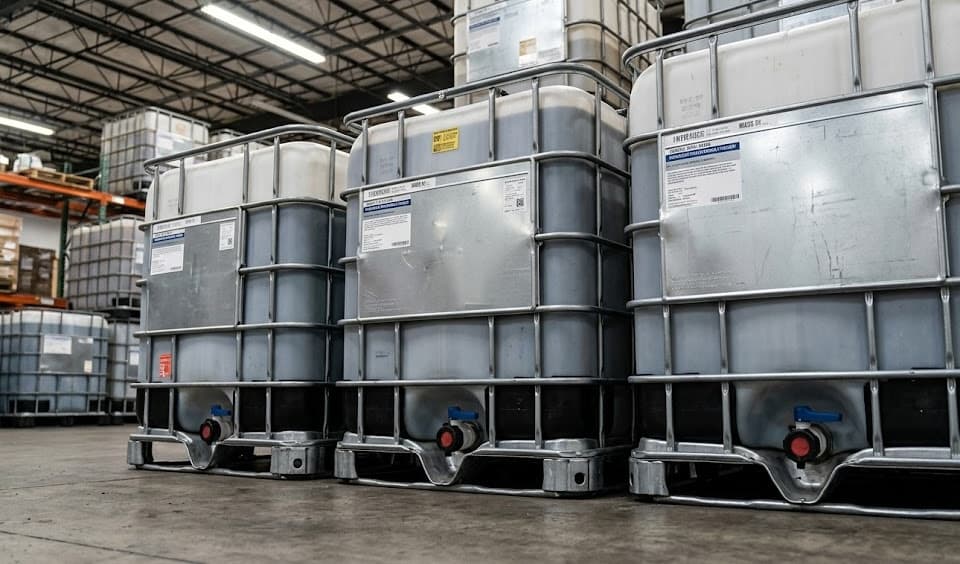
See the Details Up Close
Understanding IBC dimensions, valve sizes, and cage construction is essential for planning your storage layout, selecting the right fittings, and ensuring compatibility with your existing equipment. The reference tables below provide every measurement you need.
Dimensions by Size
All measurements are for standard composite IBC totes (HDPE bottle in steel cage) measured to the outer cage edge, including pallet height. Actual dimensions may vary by manufacturer up to +/- 1 inch.
| Size | Capacity (Liters) | Length | Width | Height | Length (cm) | Width (cm) | Height (cm) |
|---|---|---|---|---|---|---|---|
| 110 Gallon | 416 L | 36.5" | 36.5" | 37.5" | 92.7 cm | 92.7 cm | 95.3 cm |
| 275 Gallon | 1,040 L | 48" | 40" | 46" | 121.9 cm | 101.6 cm | 116.8 cm |
| 330 Gallon | 1,249 L | 48" | 40" | 53" | 121.9 cm | 101.6 cm | 134.6 cm |
| 550 Gallon | 2,082 L | 48" | 48" | 62" | 121.9 cm | 121.9 cm | 157.5 cm |
Pro Tip:The 275-gallon and 330-gallon totes share the same 48" x 40" footprint — the standard US pallet size. This means they are interchangeable on most pallet racking and fit efficiently into standard 53-foot trailers (up to 80 totes per load for 275-gal).
Weight: Empty & Full
Weights below assume water (SG 1.0) as the fill product. Heavier liquids will increase the full weight proportionally. All tare weights are for HDPE composite totes with steel cage on a wood pallet.
| Size | Empty (lbs) | Empty (kg) | Full — Water (lbs) | Full — Water (kg) | Max Gross (lbs) | Max Gross (kg) |
|---|---|---|---|---|---|---|
| 110 Gallon | 100 lbs | 45 kg | 1,018 lbs | 462 kg | 1,500 lbs | 680 kg |
| 275 Gallon | 130 lbs | 59 kg | 2,425 lbs | 1,100 kg | 2,750 lbs | 1,247 kg |
| 330 Gallon | 145 lbs | 66 kg | 2,899 lbs | 1,315 kg | 3,300 lbs | 1,497 kg |
| 550 Gallon | 195 lbs | 88 kg | 4,787 lbs | 2,172 kg | 5,500 lbs | 2,495 kg |
Important:Stainless-steel IBCs weigh significantly more empty — a 275-gallon stainless IBC typically weighs around 250-300 lbs (113-136 kg) empty. Always confirm the max gross weight with the manufacturer's data plate on the cage before filling.
Material Options
IBC totes are manufactured in two primary material families, each suited to different chemical compatibilities and temperature ranges.
HDPE (Composite) IBC
Most Common
- + Lightweight and cost-effective
- + Excellent chemical resistance to acids, bases, and most solvents
- + FDA-compliant options available for food-grade applications
- + Inner bottle is replaceable (rebottling) to extend cage life
- + Temperature range: -40 °F to 150 °F (-40 °C to 65 °C)
- - Not suitable for flammable solvents (static risk)
- - Degrades with prolonged UV exposure
- - Typical service life: 5-7 years (depending on UV and product)
Best for: Water, soaps, fertilizers, food ingredients, non-flammable chemicals, agricultural products.
Stainless Steel IBC
Premium / Specialty
- + Withstands high temperatures: up to 400 °F (204 °C)
- + Non-porous — no absorption or leaching of flavors/chemicals
- + Compatible with flammable and aggressive solvents
- + Extremely durable — 20+ year service life
- + CIP (Clean-in-Place) capable for pharmaceutical and food use
- - 3-5x the cost of HDPE composite
- - Heavier empty weight (250-350 lbs for 275 gal)
- - Susceptible to corrosion from chlorides and strong acids
Best for: Pharmaceuticals, cosmetics, flammable chemicals, food/beverage production, high-purity applications.
| Property | HDPE Composite | 304 Stainless Steel | 316L Stainless Steel |
|---|---|---|---|
| Typical Cost (275 gal, new) | $250 - $450 | $1,200 - $2,000 | $1,800 - $3,000 |
| Max Temperature | 150 °F (65 °C) | 400 °F (204 °C) | 400 °F (204 °C) |
| Chloride Resistance | Excellent | Moderate | Excellent |
| FDA Food Grade | Available | Yes | Yes |
| UN/DOT Certified | Yes (31HA1) | Yes (31A) | Yes (31A) |
| Typical Service Life | 5-7 years | 20+ years | 20+ years |
| Recyclability | High (HDPE is #2 plastic) | Very High (100% recyclable) | Very High (100% recyclable) |
Valve Sizes & Types
The discharge valve at the bottom of the tote controls flow rate and compatibility. Choosing the right valve matters for efficiency and safety.
| Valve Type | Sizes Available | Flow Rate | Best For | Notes |
|---|---|---|---|---|
| Butterfly Valve | 2" (DN50), 3" (DN80) | High (full-bore opening) | Water, thin liquids, fast dispensing | Most common on HDPE totes; gasket material varies by chemical |
| Ball Valve | 2" (DN50), 3" (DN80) | Very High | Viscous liquids, chemical applications | Better seal than butterfly; preferred for hazmat; more expensive |
| Camlock Adapter | 2" only | Moderate | Quick-connect hose applications | Attaches to existing butterfly or ball valve outlet |
| Sight Glass Valve | 2" (DN50) | Moderate | Food & beverage, pharmaceutical | Allows visual product inspection during dispensing |
Top Fill Opening
Standard top openings are 6 inches (150 mm) or 8 inches (200 mm) in diameter. The 8-inch opening is recommended for viscous products and easier interior cleaning. All openings use a screw-on cap with a vented or non-vented gasket.
Thread Standards
Most North American totes use NPS (National Pipe Straight) threads. European totes may use S60x6 or S75x6 coarse buttress threads. Always verify thread type before ordering replacement valves or adapters.
Gasket Materials
EPDM: Best for water-based products, food grade. Viton (FKM): Chemical-resistant for solvents and fuels. PTFE: Universal chemical compatibility, required for pharmaceutical applications. Always match gasket to product.
Pallet / Base Types
The pallet is the structural base of the IBC. It affects weight capacity, hygiene, forklift compatibility, and cost.
| Pallet Type | Material | Weight | Pros | Cons | Ideal Use |
|---|---|---|---|---|---|
| Wood Pallet | Heat-treated hardwood | 35-50 lbs | Lowest cost; easy to repair; widely available | Absorbs moisture; splinters; ISPM-15 heat treatment required for export | General chemical, non-food applications |
| Plastic Pallet | HDPE or PP | 25-35 lbs | Hygienic; washable; no pest risk; lighter | Higher upfront cost; harder to repair | Food, beverage, pharma, clean-room |
| Steel Pallet | Galvanized or powder-coated steel | 55-80 lbs | Maximum durability; fire-resistant; high load capacity | Heaviest; highest cost; can rust if coating is damaged | Heavy-duty industrial; stainless IBCs; hazmat |
Complete Size Comparison
All specifications in one table for quick side-by-side comparison. Values are for standard HDPE composite totes with steel cage on wood pallet.
| Specification | 110 Gallon | 275 Gallon | 330 Gallon | 550 Gallon |
|---|---|---|---|---|
| Capacity (Liters) | 416 L | 1,040 L | 1,249 L | 2,082 L |
| Footprint (in) | 36.5 x 36.5 | 48 x 40 | 48 x 40 | 48 x 48 |
| Height (in) | 37.5 | 46 | 53 | 62 |
| Tare Weight | 100 lbs | 130 lbs | 145 lbs | 195 lbs |
| Gross Weight (water) | 1,018 lbs | 2,425 lbs | 2,899 lbs | 4,787 lbs |
| Standard Valve | 2" Butterfly | 2" Butterfly | 2" Butterfly | 2" or 3" |
| Top Opening | 6" | 6" or 8" | 6" or 8" | 8" |
| Stackable | Yes (2 high) | Yes (2 high) | Yes (2 high) | Varies |
| Per Truckload (53') | ~120 | ~80 | ~60 | ~40 |
| Avg. Used Price | $50 - $80 | $75 - $150 | $100 - $175 | $200 - $350 |
* The 275-gallon column is highlighted because it represents the industry standard and our most popular size. Prices are approximate and vary by condition, region, and quantity.
Which Size Is Right for You?
Choosing the right IBC size depends on your volume needs, available storage space, forklift capacity, and how you plan to dispense the product.
110 Gallon
Compact & Portable
The 110-gallon IBC is ideal when you need a manageable volume that a single operator can work with. Its smaller footprint fits in tight spaces, pickup truck beds, and smaller storage areas.
Best applications:
- Small-batch manufacturing
- Residential rainwater collection
- Mobile pressure washing rigs
- Farm irrigation and pesticide mixing
- Craft breweries and distilleries
275 Gallon
Industry Standard
The 275-gallon tote is the most widely used IBC worldwide. Its 48" x 40" footprint matches the standard US pallet, making it compatible with virtually every warehouse rack, dock, and trailer.
Best applications:
- Chemical manufacturing and distribution
- Food-grade ingredient storage
- Water treatment and distribution
- Soap, detergent, and cleaning product supply chains
- Automotive fluids (coolant, washer fluid, DEF)
330 Gallon
Extra Capacity, Same Footprint
The 330-gallon IBC uses the same 48" x 40" pallet footprint as the 275 but is 7 inches taller, holding 20% more product. If your racks can accommodate the extra height, this is a cost-efficient upgrade.
Best applications:
- Bulk liquid transport where maximizing payload per pallet position matters
- Agricultural fertilizers and crop protection
- Industrial cleaning solutions
- Waste oil and used coolant collection
- High-volume beverage ingredient storage
550 Gallon
Maximum Volume
The 550-gallon IBC is the largest standard size. With a 48" x 48" footprint, it requires wider aisles and heavier-duty forklifts. It is typically used in stationary applications or where truck-to-tank transfers justify the extra capacity.
Best applications:
- Large-scale water storage and emergency reserves
- Bulk fuel and lubricant depots
- Mining and construction site fluid management
- Wastewater treatment plants
- Chemical blending operations with high throughput
Industry-Specific Recommendations
Based on our experience serving hundreds of Baltimore-area businesses, here are our recommended configurations for common industries.
| Industry | Recommended Size | Material | Valve | Pallet | Notes |
|---|---|---|---|---|---|
| Food & Beverage | 275 gal | HDPE (food-grade) or 316L SS | 2" Butterfly, EPDM gasket | Plastic | FDA-compliant bottle required; 8" top fill for cleaning |
| Chemical Mfg. | 275 or 330 gal | HDPE or 304 SS | 2" Ball, Viton gasket | Steel | UN-rated required for hazmat; verify SG rating |
| Agriculture | 275 or 330 gal | HDPE | 2" Butterfly, EPDM | Wood | UV-stabilized bottle if stored outdoors; used totes work well |
| Pharmaceutical | 275 gal | 316L Stainless Steel | 2" Ball, PTFE gasket | Plastic or Steel | CIP-capable; traceability required; new totes only |
| Landscaping | 110 or 275 gal | HDPE | 2" Butterfly | Wood | Used totes ideal; 110 gal fits truck beds for mobile use |
| Construction | 275 or 550 gal | HDPE | 3" Butterfly | Steel | Rugged cage essential; used/reconditioned is cost-effective |
| Water Treatment | 275 or 330 gal | HDPE | 2" Ball, Viton | Plastic | Chemical compatibility critical — verify with product SDS |
Quick Decision Guide
Not sure where to start? Answer these three questions to narrow down your ideal IBC.
Step 1
How much liquid do you need to store or transport?
- Under 100 gallons: A drum may be more practical. See IBC vs Drums
- 100 - 200 gallons: 110-gallon IBC
- 200 - 300 gallons: 275-gallon IBC (industry standard)
- 300 - 400 gallons: 330-gallon IBC
- 400+ gallons: 550-gallon IBC or multiple 275-gallon totes
Step 2
What product will the IBC hold?
- Water, food ingredients, soaps: HDPE composite with food-grade certification
- Non-hazardous chemicals: HDPE composite (standard)
- Hazardous chemicals: HDPE with UN rating or stainless steel
- Flammable solvents: Stainless steel (anti-static grounding required)
- Pharmaceutical / high-purity: 316L stainless steel
Step 3
New, reconditioned, or used?
- New: Required for food-grade first-use, pharmaceutical, and hazmat. Full warranty and traceability.
- Reconditioned: Professionally cleaned, inspected, and re-certified. 40-60% savings vs new. Great for most applications.
- Used (as-is): Best value for non-critical applications like rainwater, irrigation, waste collection. 60-80% savings.
Read our full Buying Guide for a detailed breakdown of each condition tier.
Specialty IBC Types & Sizes
Beyond the standard four sizes, there are several specialty IBC configurations for specific applications.
| Type | Capacity | Dimensions | Material | Use Cases |
|---|---|---|---|---|
| Stainless Steel IBC (275 gal) | 275 gal / 1,040 L | 48" x 40" x 46" | 304 or 316L Stainless Steel | Pharma, food/bev, flammable chemicals, CIP applications |
| Heated / Jacketed IBC | 275 gal / 1,040 L | 48" x 40" x 48" | HDPE or SS with heating jacket | Viscous products (wax, chocolate, oils) requiring temp control |
| UN-Rated Hazmat IBC | 275 gal / 1,040 L | 48" x 40" x 46" | HDPE (31HA1) or SS (31A) | DOT-regulated hazardous material transport |
| Folding / Collapsible IBC | 275 gal / 1,040 L | 48" x 40" x 46" (16" collapsed) | HDPE with flexible liner | Return shipping efficiency; reduces empty return volume by 70% |
| Aseptic / Bag-in-Box IBC | 275 gal / 1,040 L | 48" x 40" x 46" | Steel cage with disposable liner bag | Sterile food, pharma, and cosmetic applications |
| Double-Wall / Insulated IBC | 275 gal / 1,040 L | 52" x 44" x 50" | HDPE with polyurethane foam insulation | Temperature-sensitive products; cold chain logistics |
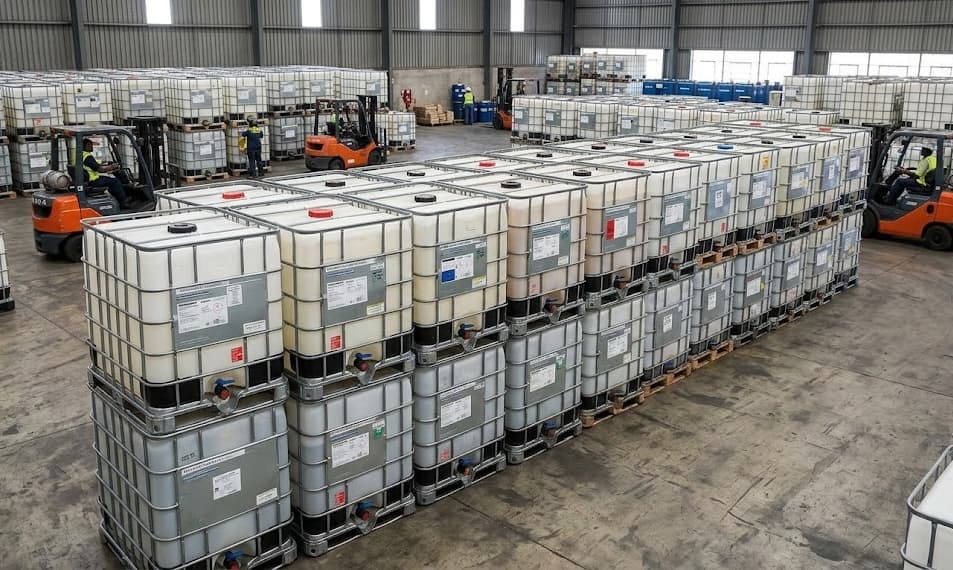
Safe stacking starts with knowing your tote specifications
Follow manufacturer load ratings and our guidelines below
Stacking Guidelines
Proper stacking is critical for safety, space efficiency, and preventing cage damage. Follow these guidelines based on IBC condition.
| Condition | Max Stack Height | Max Weight per Unit | Requirements |
|---|---|---|---|
| Full (standard 275 gal) | 2 high | 2,750 lbs gross | Level ground; cage properly aligned; check data plate for specific rating |
| Full (330 gal) | 2 high | 3,300 lbs gross | Height clearance required (106" for 2-high stack) |
| Full (550 gal) | 1 high only | 5,500 lbs gross | Most 550-gal totes are not rated for stacking due to weight |
| Empty (all sizes) | 3 high max | N/A | Cages are less rigid when empty; secure against wind; avoid if cage is damaged |
| Damaged cage | Do Not Stack | N/A | Any tote with bent, twisted, or broken cage components should not be stacked |
Stacking Do's
- Always stack on level, solid ground (concrete or asphalt)
- Verify cages are aligned before placing the upper tote
- Check that the stacking frame on the top of the lower tote is locked in position
- Use a forklift with overhead guard for placing upper totes
- Leave adequate clearance for forklift mast when stacking in warehouses
Stacking Don'ts
- Never stack more than 2 high when full (unless manufacturer specifies otherwise)
- Never stack different sizes on top of each other
- Never stack on soft, uneven, or sloped ground
- Never stack totes with damaged or misaligned cages
- Never stack in high-wind areas without securing the upper tote
How to Measure Your IBC
Accurate measurements are essential for confirming IBC size, verifying fit in your racks, calculating truck loads, and ordering replacement parts.
Length (L)
Measure from the outer edge of the cage on one side to the outer edge on the opposite side, along the longer dimension. For a standard 275-gallon tote, this should read approximately 48 inches. Measure at the base, not the top, as cage damage can cause slight misalignment at the top rails.
Width (W)
Measure from the outer edge of the cage on one side to the outer edge on the opposite side, along the shorter dimension. For a standard 275-gallon tote, this should read approximately 40 inches. This is also the direction of the forklift entry on the pallet.
Height (H)
Measure from the bottom of the pallet to the top of the cage frame (including the stacking frame when it is in the upright/locked position). This is the total shipping height. For a 275-gallon tote, expect approximately 46 inches. For stacking calculations, double this measurement plus 2 inches for clearance.
Valve Height (from ground)
Measure from the floor to the center of the bottom discharge valve opening. This measurement determines whether your dispensing equipment, hoses, and containment trays will fit. Typical valve center height is 8-12 inches from the ground, depending on pallet height.
Fork Pocket Dimensions
Measure the opening height (typically 3.5-4 inches), opening width (distance between fork pockets, typically 24-28 inches center-to-center), and depth (how far forks can enter, typically 36-40 inches). These measurements ensure your forklift is compatible.
Shipping Dimension Considerations
Maximizing trailer utilization requires knowing exactly how IBCs fit in standard trailers and how many you can ship per load.
| IBC Size | Per 53' Trailer (single layer) | Per 53' Trailer (double stack) | Max Gross per Trailer | Weight Limit (44K lbs payload) |
|---|---|---|---|---|
| 110 Gallon | ~60 | ~120 | 6,000 lbs (empty) | 43 full totes |
| 275 Gallon | ~40 | ~80 | 5,200 lbs (empty) | 18 full totes |
| 330 Gallon | ~40 | ~60 (height limited) | 5,800 lbs (empty) | 13 full totes |
| 550 Gallon | ~20 | ~40 (if stackable) | 3,900 lbs (empty) | 8 full totes |
Key shipping rule: When shipping full IBCs, weight limits are almost always the constraint, not volume. A 53-foot trailer can hold 80 empty 275-gallon totes, but only 18 full ones (at 2,425 lbs each) before hitting the standard 44,000 lb payload limit. Always calculate both volume and weight when planning shipments.
Regulatory Size Requirements
Several regulations affect IBC sizing, marking, and usage. Here are the key regulatory frameworks that apply to IBC containers in the United States.
DOT / UN Certification (49 CFR 178)
- All IBCs used for hazardous material transport must be UN-certified and marked
- HDPE composite IBCs are classified as UN 31HA1
- Stainless steel IBCs are classified as UN 31A
- Maximum capacity for UN-rated HDPE IBCs: 3,000 liters (793 gallons)
- HDPE bottles must be replaced or reconditioned within 5 years of manufacture date for continued DOT-regulated use
- Reconditioned totes for hazmat use must be inspected and re-marked by a certified reconditioning facility
FDA / Food-Grade Requirements (21 CFR)
- HDPE used for food-contact IBCs must be FDA-compliant virgin resin
- Food-grade totes must have documentation of compliance available
- Reused totes for food contact must be rebottled with new food-grade bottles (used bottles cannot be re-certified for food use)
- No size restriction from FDA — the food-grade requirement is about material composition, not dimensions
OSHA Workplace Safety (29 CFR 1910)
- IBCs containing flammable liquids must meet NFPA 30 storage requirements
- HDPE totes are not suitable for flammable liquids without proper grounding and bonding (static discharge risk)
- Stacking must comply with manufacturer specifications — OSHA requires documented load ratings
- IBCs in pedestrian areas must be secured against tipping and positioned to allow emergency egress
ISPM-15 (International Shipping)
- Wood pallets on IBCs shipped internationally must be heat-treated and ISPM-15 stamped
- Plastic and steel pallets are exempt from ISPM-15 requirements
- If exporting, verify the ISPM-15 stamp is present and legible on the pallet before shipping
Need Help Choosing the Right IBC?
Our team has configured thousands of IBC setups for Baltimore-area businesses. Tell us your application, and we will recommend the perfect size, material, and condition — at the best price.